

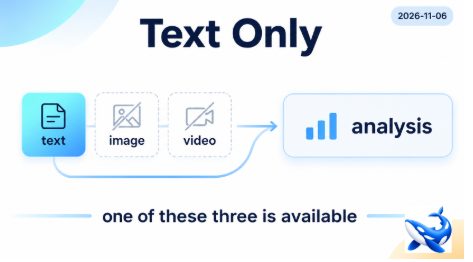
On OrcaRouter the three cards released the same day differ first in what they accept. Three security cards were released on the same day, and the difference between them is not their benchmark scores — none of the three has published any. It is narrower and more operational. OrcaCyber GLM 5.3 accepts text only, while its two siblings accept image and video as well [OURS]. That single line decides which triage work each card can take, and it is the first thing to check before the price.
The card itself is $3 in / $5 out / $0.30 cache through OrcaRouter, with a 1,000,000-token context, a 128,000-token output ceiling, tools, JSON and reasoning, and the security gate every OrcaCyber card carries.
What text-only costs you in practice
A security workflow that only ever reads logs, code and configuration is unaffected. A workflow that reads screenshots, screen recordings, packet captures rendered as images, or photographs of hardware is not.
The three artefacts that matter:
Screenshots. A failing console, a debugger, a configuration UI — the fastest path into many incidents is a screenshot, and a text-only card needs someone to describe it first. That is the transcription step, and it is where detail gets lost.
Screen recordings. Reproducing a reported bug from a recording is precisely the job that benefits from a model that watches it, which is why the other two cards in this batch advertise video input.
Rendered captures. A packet capture visualised, a dashboard, a terminal with colour-coded severity — all of them arrive as images in practice even when the underlying data is text.
If your queue is text, none of this matters and the card is a clean choice. If any of it is visual, this is the wrong card in this batch and the choice is between the other two.
The price comparison that matters
Against its base — Z.ai’s GLM 5.3 — the card follows the pattern the whole line has established: a premium on input, a smaller one on output, and a blended multiple that lands in the middle [OURS].
| line | base | OrcaCyber | multiple |
| input | $1.26 | $3.00 | 2.38× |
| output | $3.96 | $5.00 | 1.26× |
| cache | $0.234 | $0.30 | 1.28× |
| blended 3:1 | $1.935 | $3.50 | 1.81× |
The output multiple is the smallest in the security line: the base’s output rate is high enough that removing refusals only adds 26%. A workload that writes a lot and reads a little pays the least for the abliteration here — the inverse of the DeepSeek-derived card, where input carries a 5.33× multiple and output 2.67×.
What the card is good for
Long text analysis with a fixed artefact. A million-token context and a 128,000-token ceiling suit a repository, a log archive or a corpus that does not change between questions. Cache reads at $0.30 per million — 10% of input — make re-sending that artefact cheap [OURS].
Refusal-sensitive reasoning over code and prose. The reason to pay the premium is that the base model declines a class of requests. If your work never trips that, the base card is the correct purchase and this one is 1.81× the price for a capability you are not using.
Batch, not chat. 75.6 tokens per second and a p50 of 3,552 ms over three days [OURS] describe a card that finishes a job rather than one that answers a person. That is consistent with the rest of the line.
The two numbers that are still provisional
No published benchmarks, three days in [VENDOR]. A security card without a single evaluation row is a card whose capability you have to establish yourself.
An error rate of 19.899% [OURS], which on a gated card counts rejected access attempts. Its two siblings read 19.462% and 5.221% in the same window; the ungated base reads 0.328%, and the ungated base Kimi reads 15.506%. The column is measuring deployments, not models, and three days is not a window you can plan with.
What the missing modalities cost a queue
A text-only card is not a smaller version of a multimodal one; it changes the shape of the workflow in front of it.
A transcription step appears. Every screenshot in the queue needs a human or a second model to turn it into text before this card can see it. That is a cost per artefact, and it is paid in the same currency as the model: time and tokens.
The second model has a second bill. If the transcription is done by a vision card, the pipeline now has two vendors’ worth of latency and two error rates to reason about, on a job whose total budget was set when it was one call.
The evidence chain gets a gap. A description of a screenshot is not the screenshot. When the finding is challenged, the chain runs through a summariser that nobody audited.
For a queue that never contains images, none of this applies and the card is the cheapest of the three. For a queue that does, the missing modality is a fixed tax on every session.
The two-model pipeline, priced
If the queue does contain images, the honest comparison is not this card against its siblings — it is this card plus a vision step against a multimodal card.
A vision transcription of one screenshot costs roughly $0.001 to $0.003 on a flash-tier card, plus the latency of a second call. Add that to every artefact and the “cheaper” text-only path stops being cheaper as soon as the queue has more than a few images, and the error rates of two models compound.
At that point the multimodal sibling — $0.80 and $1.60 for Hy4, $0.80 and $1.60 for the MiniMax variant [OURS] — is the simpler purchase, even though its per-token price looks higher than this card’s output multiple. Simpler is the operative word: one model, one error rate, one bill, and no stage where a screenshot becomes a paragraph.
The takeaway
OrcaCyber GLM 5.3 is the text-only member of a three-card release: $3 in / $5 out, a 1M context, a 128,000-token ceiling, and the smallest output multiple in the line at 1.26×. Choose it when the queue is text and the artefact is long; choose a sibling when screenshots or recordings are part of the evidence. The price is settled, the benchmarks are absent, and the error column is still onboarding traffic.
Sourcing note: pricing, cache rates, context, output ceiling, modalities, latency, throughput, error rate and traffic figures are OrcaRouter production telemetry for the seven days ending 2026-11-05 [OURS]; the card was released 2026-11-04. The base card is Z.ai GLM 5.3 on the same gateway. No benchmark rows are published for this card and none are quoted. Access is restricted to authorized security research. Checked 2026-11-06.