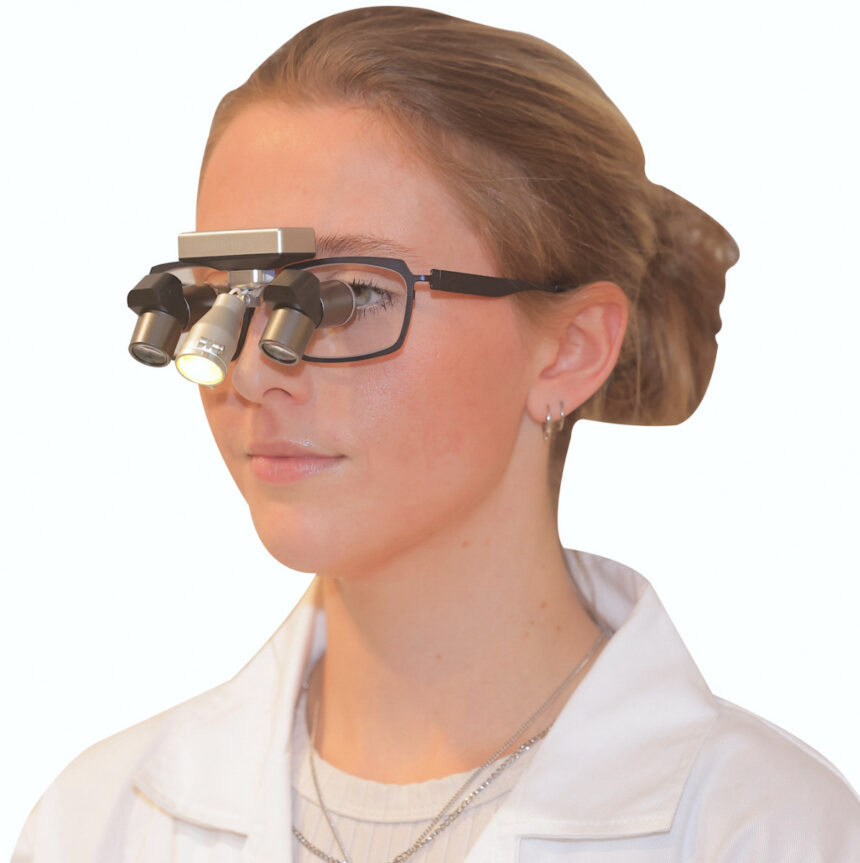
Good visibility is fundamental to precise dental work. A dental headlight provides focused illumination directly where the clinician is working, helping reduce shadows and improve visibility inside the oral cavity. Unlike room lighting, it moves with the clinician’s line of sight.
Not every headlight offers the same practical advantages. Brightness, beam quality, battery performance, weight, positioning, and compatibility with loupes can all affect how useful the system is during a procedure. The right choice should therefore be based on clinical workflow, not brightness alone.
Why a Dental Headlight Matters in Clinical Work
Dental procedures often involve small working areas where ambient lighting cannot provide consistent illumination. The clinician may also create shadows simply by positioning their head, hands, or instruments between the overhead light and the treatment area.
A head-mounted light addresses this problem by placing illumination close to the clinician’s visual axis. This can make the working field easier to inspect without requiring constant repositioning of an operatory light.
Consistent illumination can be particularly valuable during restorative procedures, endodontic work, examinations, and other tasks where distinguishing fine details matters. The goal is not simply to produce more light, but to place useful light precisely where it is needed.
The Main Features to Evaluate
When comparing dental headlights, pay attention to:
- Illumination intensity
- Beam shape and uniformity
- Color quality
- Weight and balance
- Battery capacity and charging
- Light positioning
- Loupe compatibility
- Cable or wireless configuration
- Ease of cleaning and maintenance
Each feature affects the system differently. A very bright light may still be uncomfortable if it is poorly balanced, while a lightweight system may be less useful if its beam is inconsistent.
Brightness Is Important, but Beam Quality Matters Too
Brightness is one of the first specifications clinicians notice, but maximum output does not tell the whole story. What matters clinically is how effectively that illumination reaches the working field.
A concentrated, uniform beam can provide more useful visibility than a brighter light with uneven illumination. Hot spots, excessive spill, or inconsistent edges can make it harder to assess details comfortably over long procedures.
What to Look for in the Beam
A useful beam should provide:
- Consistent illumination: The central working area should remain evenly lit.
- Appropriate coverage: The beam should correspond reasonably well with the clinician’s field of view.
- Minimal distraction: Excessive glare or unnecessary spill should not interfere with concentration.
- Stable positioning: The beam should remain aligned as the clinician changes posture.
These characteristics are particularly important when a light is used with magnification, because the illuminated area needs to remain coordinated with the magnified field.
Color Quality Supports Accurate Visual Assessment
Brightness alone cannot reproduce useful clinical information. The quality of the light also affects how tissues, tooth structures, restorative materials, and other details appear.
Color rendering is therefore an important consideration when comparing lighting systems. A light source with appropriate color characteristics can help clinicians distinguish subtle differences more naturally than a source with poor color performance.
This is one reason specifications should be reviewed as a group. Illumination intensity, color quality, beam characteristics, and optical alignment work together to determine the actual visual experience.
Ergonomics Should Be Treated as a Clinical Feature
A headlight sits on the clinician’s head for extended periods, so weight and balance are not minor considerations. Even a technically capable light can become uncomfortable if its mass is concentrated too far forward or if the mounting system creates unnecessary pressure.
An ergonomic setup should complement the clinician’s existing loupes rather than forcing awkward head or neck positions. The light should remain aligned with the working field without requiring repeated adjustment.
This is especially relevant during lengthy procedures. Small ergonomic disadvantages can become more noticeable over several hours, making weight distribution, adjustability, and mounting design worth evaluating before purchase.
Wireless Design and Battery Performance
Wireless systems can reduce the practical inconvenience associated with cables running from the head-mounted light to a separate power source. This can give clinicians greater freedom of movement during procedures.
Battery performance should be evaluated alongside charging requirements. A system that lasts through the clinician’s typical working schedule is more useful than one requiring frequent interruptions for charging.
For clinicians comparing systems, factors such as what to consider when buying a wireless dental headlight can help put battery life, portability, and daily workflow into perspective.
Battery Questions to Ask
Before selecting a wireless light, check:
- Expected operating time per charge
- Charging method
- Recharge time
- Availability of battery indicators
- Ease of swapping or recharging the power source
- Whether brightness settings affect operating duration
Actual battery life can vary according to output settings and usage patterns, so manufacturer specifications should be considered in the context of how the light will be used.
Dental Headlight Compatibility With Loupes
For clinicians who already use magnification, compatibility is essential. A headlight should align with the loupe’s optical path without creating excessive weight or an awkward mounting position.
Poor alignment can undermine the benefit of both systems. If the light points away from the magnified field, the clinician may need to compensate with head movement or repeated adjustments.
When assessing compatibility, consider the mounting mechanism, adjustment range, weight distribution, and whether the light can be positioned close enough to the optical axis. The complete loupe and lighting setup should function as one system.
LED Surgical Headlight Technology in Dental Applications
An LED surgical headlight can provide the concentrated illumination required in settings where detailed visualization is important. LED technology is widely used for portable clinical lighting because it can deliver substantial illumination from a relatively compact light source.
For dental applications, however, the relevant question is not whether a light uses LEDs. The more useful questions concern output, beam consistency, color characteristics, heat management, battery operation, and ergonomics.
A dental clinician should evaluate an LED system according to the actual demands of the procedure. Surgical-style illumination does not automatically make a headlight appropriate for dentistry, so specifications and mounting compatibility still need careful consideration.
Why Schultz Loupes Stands Out for Ergonomic Loupes
For clinicians investing in magnification, ergonomics deserve the same attention as optical performance. Schultz Loupes focuses on ergonomic loupes designed around practical clinical use, helping professionals consider posture, working distance, comfort, and visual access as part of the magnification decision.
Pairing well-designed ergonomic loupes with appropriately positioned illumination can create a more cohesive clinical setup. The objective is to maintain clear visualization without introducing unnecessary strain or constant equipment adjustments.
Conclusion
The most important dental headlight features extend beyond raw brightness. Beam uniformity, color quality, weight, balance, battery performance, adjustability, and compatibility with loupes all influence whether a lighting system performs well during real procedures.
A useful evaluation starts with the clinician’s workflow. Consider the procedures performed most often, the required working distance, typical procedure length, existing magnification system, and need for wireless mobility. This makes it easier to select illumination based on practical clinical requirements rather than specifications in isolation.