

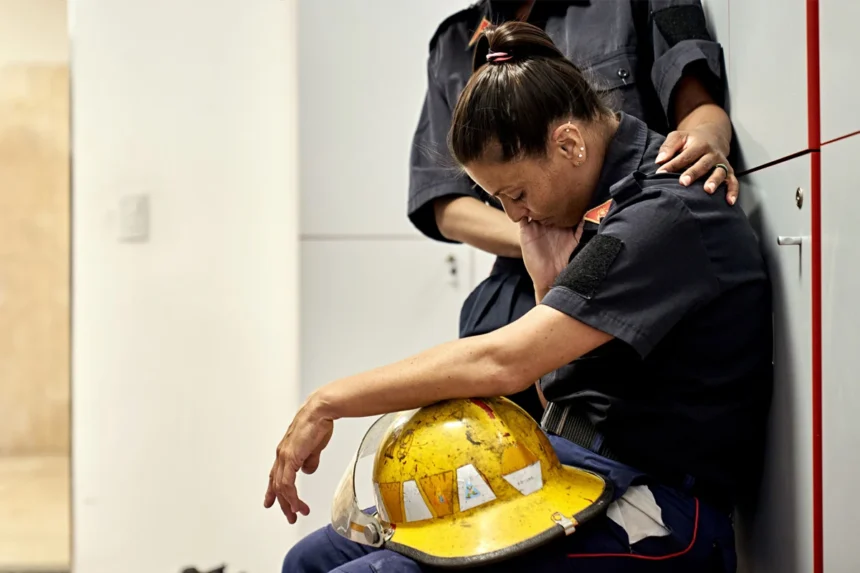
Every shift, firefighters, paramedics, law enforcement officers, and dispatchers absorb experiences that most people will never encounter in a lifetime. Over time, that accumulation takes a measurable toll. Yet the culture surrounding first responder work has historically treated psychological distress as a sign of weakness rather than a predictable consequence of the job. That gap between reality and culture has cost lives, and it is finally starting to close.
This article examines what the research actually shows about mental health among first responders, why the standard approaches to workplace wellness often fall short for this population, and what kinds of support have demonstrated real results. Whether you work in emergency services, love someone who does, or simply want to understand the issue better, the picture that emerges is both sobering and genuinely hopeful.
The Scope of the Problem
The statistics are stark. According to the Ruderman Family Foundation, first responders are more likely to die by suicide than in the line of duty. In 2017, an estimated 103 firefighters and 140 police officers died by suicide, compared to 93 firefighters and 129 officers killed in the line of duty. Those numbers reflect a pattern that researchers have been tracking for years across multiple countries and across all branches of emergency services.
Post-traumatic stress disorder affects somewhere between 15 and 37 percent of first responders, compared to roughly 20 percent of military veterans and about 7 percent of the general population, according to data published in the Journal of Emergency Medical Services. Depression and anxiety rates follow a similar pattern. Substance use disorders are also significantly elevated, partly because alcohol and other substances are sometimes used as informal coping tools when formal support is unavailable or stigmatized.
What makes this population distinct is not just the frequency of traumatic exposure, but the chronic, cumulative nature of it. A single catastrophic event can trigger PTSD in anyone. But first responders often experience hundreds of disturbing incidents over a career, layered on top of rotating shift work, sleep deprivation, physical danger, bureaucratic frustration, and strained family relationships. The result is a stress load that is qualitatively different from what most mental health frameworks were designed to address.
Why Stigma Runs Deep in Emergency Services Culture
Understanding the stigma problem requires understanding the occupational identity at play. First responders are trained to project control and competence in chaotic situations. That is not just a professional skill; it becomes part of how a person sees themselves. Admitting to anxiety, depression, or trauma symptoms can feel like a direct contradiction of that identity, not simply an admission of struggle.
There is also a legitimate practical concern. In some jurisdictions and some agencies, disclosing mental health struggles can affect a first responder’s ability to carry a firearm, maintain a security clearance, or stay on active duty. Fear of career consequences is not irrational. It is a real barrier that mental health advocates and policymakers are still working to dismantle through legislation and updated departmental policies.
Peer pressure operates in both directions. Some agencies have made genuine progress in normalizing help-seeking, with peer support programs, embedded mental health clinicians, and leadership figures who speak openly about their own experiences. In those environments, the culture shifts. In agencies where leadership still treats psychological struggles as personal failings, the culture stays toxic for mental health regardless of what formal resources exist on paper.
Types of Mental Health Support That Work for First Responders
Not all mental health support is equally effective for this population. General employee assistance programs, while useful in many workplaces, often feel disconnected from the realities of emergency services work. A therapist who has never encountered occupational trauma specific to law enforcement or fire service may inadvertently minimize or misframe a client’s experience. That disconnect can cause first responders to disengage from treatment quickly.
Specialized approaches tend to produce better outcomes. These include clinicians with specific training in first responder culture and trauma, peer support specialists who are themselves current or retired emergency personnel, and trauma-focused therapeutic modalities such as EMDR (Eye Movement Desensitization and Reprocessing) and Cognitive Processing Therapy, both of which have strong evidence bases for trauma treatment.
| Support Type | Key Feature | Best Evidence For |
| Peer Support Programs | Credibility through shared experience | Early intervention, stigma reduction |
| Embedded Clinicians | On-site access within the department | Reducing barriers to help-seeking |
| EMDR Therapy | Trauma memory processing technique | PTSD symptoms, acute trauma |
| Cognitive Processing Therapy | Restructuring trauma-related beliefs | PTSD, depression, guilt |
| Critical Incident Stress Debriefing | Group processing after major incidents | Short-term distress, team cohesion |
| Family Support Services | Involving household members in care | Relationship strain, secondary trauma |
Family-based support deserves particular mention. The spouses, partners, and children of first responders absorb secondary trauma in ways that are often overlooked. When a firefighter comes home from a brutal shift and cannot talk about what happened, the silence itself creates strain. When the household becomes attuned to a first responder’s hypervigilance or emotional withdrawal, family members develop their own stress responses. Programs that include family members in the support ecosystem tend to produce more durable recovery outcomes.
Community-Level Responses and Local Resources
National awareness campaigns and federal policy conversations are valuable, but meaningful change tends to happen at the local and regional level. Departments, unions, community health organizations, and local governments can move faster than federal systems and are better positioned to understand the specific pressures facing first responders in a given area.
Southern California has seen growing investment in this space. For example, resources available at frca.health/communities-served/orange-county/first-responder-mental-health-garden-grove/ reflect the kind of community-specific approach that research supports, connecting first responders in Garden Grove and the broader Orange County area with mental health services that are designed specifically for their occupational context rather than adapted from general public programs.
Local programs benefit from proximity and cultural familiarity. A clinician embedded in a community where they understand the local department’s structure, the specific stressors of the regional landscape, and the informal norms of the local first responder culture is more likely to build trust quickly. Trust is not incidental to effective mental health treatment. It is foundational.
What Good Prevention Actually Looks Like
Too much of the conversation about first responder mental health is reactive. The focus lands on crisis intervention, suicide prevention hotlines, and treatment for diagnosable conditions. All of that matters, and all of it saves lives. But prevention work upstream, before distress becomes disorder, is where sustained cultural change happens.
Evidence-based prevention in this context typically includes several distinct components.
- Regular psychological check-ins that are normalized as occupational health rather than flagged as signs of struggle
- Resilience training that teaches emotional regulation and stress management skills before a crisis occurs
- Leadership development that equips supervisors to recognize distress early and respond without stigmatizing
- Sleep hygiene and fatigue management programs, given how profoundly sleep deprivation amplifies psychological vulnerability
- Clear, confidential pathways to seek help that are separated from fitness-for-duty evaluations
- Peer support networks with trained personnel who are available around the clock, matching the schedules first responders actually work
The goal of prevention is not to make first responders immune to the psychological effects of their work. That is neither realistic nor necessary. The goal is to build the kind of organizational and personal resilience that allows people to process difficult experiences without those experiences accumulating into chronic impairment. Small, consistent support structures tend to outperform large, infrequent interventions.
The Role of Policy and Leadership in Driving Change
Individual clinicians and peer supporters can only do so much within a system that does not structurally support them. Policy change at the agency, municipal, and state level is what creates lasting conditions for better mental health outcomes across entire first responder populations.
Several states have passed legislation in recent years requiring mental health coverage for first responders that is separate from workers’ compensation processes, reducing the bureaucratic obstacles to seeking care. Some jurisdictions now mandate annual mental health screenings for emergency personnel, treated the same way as physical fitness evaluations. These changes matter because they shift the default. Instead of requiring individual courage to seek help, they build help-seeking into the ordinary structure of the job.
Leadership modeling is equally important. When a fire chief speaks publicly about attending therapy, when a police captain checks in on officers after a critical incident without making it transactional, when a union rep advocates for mental health benefits alongside physical ones, it signals to the rank and file that asking for help is acceptable. Culture is built from the top down as much as from the ground up, and the research on organizational change consistently supports this.
A Field That Is Still Learning
First responder mental health as a specialized field is relatively young. Many of the interventions described here have solid theoretical grounding and promising early outcomes data, but long-term longitudinal studies are still catching up to the urgency of the problem. Researchers are working to understand which combinations of support work best for which subgroups, whether by profession, tenure, type of traumatic exposure, or personal history.
What the evidence does support clearly is this: doing nothing is not a neutral choice. Departments that treat mental health as someone else’s problem, or as a personal matter entirely outside their scope, produce measurably worse outcomes for their personnel. The cost shows up in absenteeism, early retirement, compromised job performance, substance use, family breakdown, and, at the extreme end, suicide. Those costs are paid by individuals, by families, and by the communities those first responders were hired to protect.
Progress is real, and it is accelerating. The conversation that once barely existed in firehouses and patrol briefings is now part of training academies, union negotiations, and legislative chambers. That shift did not happen by accident. It happened because researchers, advocates, and survivors spoke clearly about what was happening and refused to let it stay invisible. The work is far from finished, but the direction is right.